

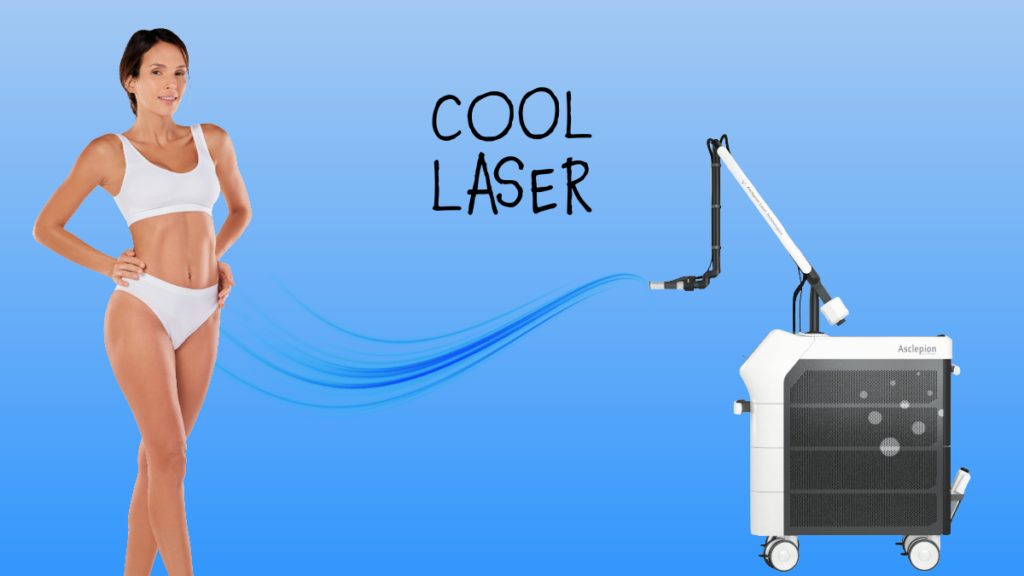
Cool Laser Trends As New Regenerative Skin Therapy Option
‘Thermal’ has been a buzzword for aesthetics treatments for so long, that a treatment which parades coolness as its selling point, warrants attention. Cool Laser is one such treatment.
Won over by its promise of minimal downtime, I wanted to find out more about this innovative trending treatment. At the same time, I was intrigued by the idea of ‘cool’ associated with a laser treatment. So I did some of my own research.
Here’s what I found out about Cool Laser.
Cool Laser is an advanced Erbium:YAG (Er:YAG) laser resurfacing treatment. The ‘cool’ of Cool Laser is deliberate. This is because it’s different to most other laser treatments. It is specifically designed to minimise thermal damage.
Unlike traditional resurfacing lasers which rely on intense heat, it works by strategically targeting water within the skin tissue. This allows practitioners to remove damaged skin in ultra-thin layers, while preserving more surrounding tissue.
The result is reduced recovery time and improved patient comfort.
However, what’s really gotten the treatment a place in the spotlight is its use of regenerative techniques. The laser treatment works by creating controlled microscopic injury in the skin, triggering the body’s natural wound-healing response. Through this, the skin is stimulated to produce more collagen.
The treatment is most commonly associated with next-generation Er:YAG resurfacing systems, such as Dermablate technology. It is used for skin rejuvenation, fine lines, acne scarring, enlarged pores, pigmentation irregularities, and sun damage.
Within these benefits lies a world of possibilities.
The laser operates at a wavelength of 2940nm, which has exceptionally high absorption in water. This enables highly controlled ablation with less residual heat compared with traditional CO2 lasers.
According to Asclepion UK, a German medical and aesthetic laser manufacturer, the technology performs ‘cold ablation’, removing tissue in micron-thin layers with minimal thermal diffusion into surrounding skin.
Reduced Recovery Time

Cool Laser treatments work by creating controlled microscopic injury in the skin, triggering the body’s natural wound-healing response and stimulating collagen remodelling.
Er:YAG lasers target water so efficiently that they generate less collateral heat than CO2 systems. This means practitioners can achieve resurfacing effects with reduced thermal injury. All of this means reduced recovery time! With lifestyles becoming increasingly busy, this is a huge plus.
Dr. Sheila Barbarino, oculoplastic surgeon and aesthetic practitioner, has explained: “Patients today are educated consumers. They want efficiency, but they also want minimal interruption to work and social life. Technologies with reduced downtime are reshaping patient expectations.”
Recovery still varies depending on treatment intensity, skin type, and treatment area. Most patients experience redness, sensitivity, and mild peeling for several days post-procedure.
Experts stress that practitioner skill remains critical. Dr. Jennifer Walden, board-certified plastic surgeon, comments, “Energy-based treatments are highly operator dependent. Patient assessment, correct settings, and appropriate aftercare all influence outcomes and safety.”
Aftercare requirements are also specific and include strict sun protection, gentle skincare, avoidance of active ingredients during healing, and hydration and barrier repair support.
The Evolution Towards ‘Cool’ Laser Treatment
It’s fascinating to look back on the evolution of laser treatment for skin aesthetics. In just the past few years, technology usage has skyrocketed and endless possibilities have unfolded.
However, laser technology has been around for longer than one might think. It has transformed aesthetic medicine over the past three decades, evolving from aggressive ablative treatments with lengthy recovery times to highly sophisticated systems, focused on precision, safety, and patient comfort.
The 1990s And CO2
Early aesthetic lasers, particularly CO2 lasers introduced in the 1990s, revolutionised skin resurfacing by effectively treating wrinkles, scars, and sun damage. However, these treatments often came with significant downtime, prolonged redness, and increased risks of pigmentation complications, particularly for darker skin types.
Fractional Laser Technology
The next phase of innovation introduced fractional laser technology, which treated microscopic sections of the skin while leaving surrounding tissue intact. This dramatically improved healing times and expanded the appeal of laser rejuvenation to a broader patient demographic.
Non-Ablative Lasers
Non-ablative lasers later emerged, stimulating collagen production with less surface damage, although results were often more subtle.
Advanced Erbium:YAG Systems
Today’s patients increasingly demand treatments that combine efficacy with convenience, driving the development of advanced Erbium:YAG systems such as Cool Laser.
A Star Treatment In The World Of Regenerative Aesthetics
Really, Cool Laser is a response to the growing demand for regenerative aesthetics. The fact that it allows for minimal downtime as a result of its ‘coolness’, and one of its most attractive benefits.
For busy executives and housewives alike, the promise of ‘less pain, more gain’ seems completely endearing.
Cool Laser may not replace every resurfacing modality, but its combination of precision, reduced downtime, and collagen stimulation positions it as a compelling option to consider.