

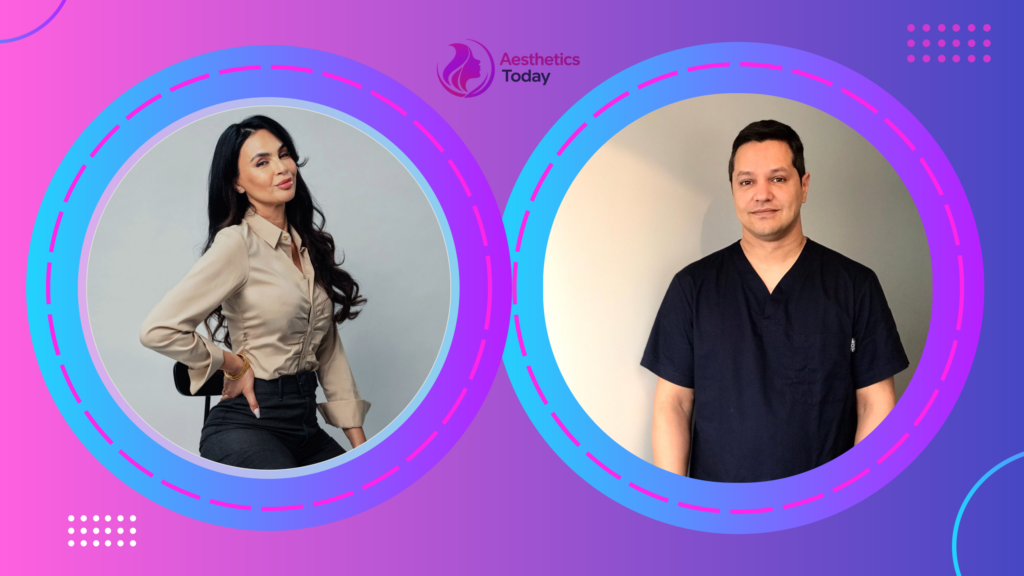
In the latest episode of the Aesthetics Today podcast, host Gabrielle Richens sits down with Dr Zunaid Alli for an exclusive wide-ranging conversation that captures one of the most important shifts currently taking place in aesthetic medicine. The move away from beauty-led quick fixes and towards medically led, regenerative, evidence-based treatment planning.
Dr Alli, founder and medical director of Edition Clinic in Wimbledon, brings an unusually broad clinical background to the field, with experience spanning emergency medicine, oncology, psychiatry, clinical psychology and general practice, alongside a Master’s in Minimally Invasive Aesthetics from UCL. The result is an interview that feels less like a standard treatment discussion and more like a state-of-the-industry examination.
The conversation begins with Dr Alli’s unlikely route into aesthetics. Originally trained in South Africa, he had planned a more conventional hospital career in the UK, with the long road of NHS specialisation mapped out ahead of him. Aesthetics, by his own admission, was not part of the plan. It entered his life almost accidentally, during a GP maternity locum role in South Africa, where injectables were part of the practice offering.
What began as a reluctant add-on soon became an area of clinical fascination. Like many practitioners in the UK, he describes aesthetics as something that often starts as a “side hustle”, before its technical, psychological and patient-facing complexity begins to pull clinicians deeper in.
What distinguishes Dr Zunaid’s perspective is his insistence that aesthetic medicine must still be medicine. Throughout the interview, he returns to the importance of consultation, patient selection, safety, diagnosis and duty of care. For him, treatment does not begin with a product, a syringe or a device. It begins with listening. Patients may arrive with a particular concern, a trend they have seen online, or a treatment they believe they need, but the practitioner’s role is to slow the process down, assess the full face, understand motivation and build a plan that is clinically appropriate rather than commercially convenient.
One of the strongest sections of the interview comes when Richens raises patient psychology. Dr Alli’s background in psychiatry and clinical psychology gives him a useful lens through which to examine body image, expectation and aesthetic decision-making. He is careful to distinguish between diagnosed body dysmorphic disorder and the more common “dysmorphic traits” that many people carry. This distinction matters. Not every patient who dislikes a facial feature has a psychiatric disorder, but practitioners must be able to recognise when a concern has become disproportionate, unrealistic or potentially harmful to treat. Dr Alli describes this as a delicate area, one requiring tact, referral networks and an ability to refuse treatment when expectations cannot safely be met.
The interview also touches on the ethical discomfort of commercial pressure inside clinics. Dr Alli draws a sharp distinction between doctor-led environments and clinics owned purely as businesses. In his view, medically led clinics tend to be less aggressive in pushing treatments, whereas business-owned models can become more target-driven, with pressure to upsell skincare, procedures or add-ons. This is one of the most revealing parts of the episode because it exposes a tension at the heart of modern aesthetics. Clinics are businesses, but treatments are still medical interventions. The best practitioners must hold both truths at once without allowing sales culture to override judgement.
Regulation, inevitably, becomes a central theme. Richens raises the confusion around who can legally perform injectables in the UK, and Dr Alli is clear that non-medics can still inject Botox and filler. His concern is not simply professional protectionism; it is patient safety. Botulinum toxin is a prescription-only medicine, and proper assessment, prescribing and product sourcing are essential. He also warns of counterfeit products, including fillers, toxins and even newer regenerative products entering the market through questionable online suppliers. He makes a good point. When a filler costs a medical practitioner around £96 but can be found online for £10, that price gap should alarm both clinicians and patients.
The discussion around threads is similarly nuanced. Dr Alli does not dismiss thread lifts outright; in fact, he trains practitioners in their use and performs them in clinic. However, he is firm that patient selection is everything. Threads are not a non-surgical facelift for everyone, and more patients are unsuitable than suitable. Where there is significant tissue laxity, poor skin quality, bony resorption or unrealistic lifting expectations, threads may simply not deliver. This is the kind of measured explanation often missing from social media-led aesthetics, where treatments are sold as universal solutions rather than tools with limitations.
The episode’s most commercially relevant theme is the industry’s movement away from a filler-first mindset. Dr Zunaid explains that for years, filler was presented as something that filled, lasted for a fixed period, disappeared, and then needed topping up. The reality has proved more complicated. Residual hyaluronic acid, the long-term accumulation of product and increased public anxiety around overfilling have all changed the conversation. He does not argue that filler is obsolete. Quite the opposite. His phrase, “filler fills”, is perhaps the clearest summary of its proper role. Where volume is lost, filler may still be the correct tool. But it is no longer the only child in the family. It now sits alongside polynucleotides, skin boosters, collagen stimulators, peels, lasers and energy-based devices.
This leads into the most forward-looking part of the interview. Regenerative aesthetics. Dr Alli is currently involved in the European launch of Rejuran with Vivacy, and his explanation of polynucleotides is one of the episode’s strongest educational moments. He traces the evolution from earlier “salmon DNA” mesotherapy concepts through PDRN and into true polynucleotides, explaining how molecular weight, chain length and tissue persistence affect performance. Rejuran, he says, differs because of its structure, which he describes as scaffold-like, allowing longer tissue contact time and, in his view, more effective healing and repair.
The under-eye area receives particular attention. According to Dr Alli, seven out of ten polynucleotide treatments performed at Edition Clinic have been for the under-eye region, a notoriously difficult area to treat. This is clinically significant because tear troughs, dark circles, crepey skin, fine lines and pigmentation concerns have historically driven patients towards filler, often with mixed results. Polynucleotides offer a different route. Not filling, but improving repair, texture and skin quality. Richens also shares her own experience of under-eye polynucleotides and carboxytherapy, framing the treatment not as dramatic alteration but as genuine improvement in an area that had troubled her for years.
Dr Alli’s breakdown of regenerative and biostimulatory categories is useful for both patients and practitioners. Skin boosters, he explains, are typically hyaluronic-acid-based products designed to hydrate and improve skin quality rather than reshape the face. Biostimulators, such as Sculptra, Radiesse, HArmonyCa and threads, work by stimulating collagen through an inflammatory response. Exosomes, meanwhile, are described as tiny messenger particles that enhance cellular communication, usually used topically after treatments such as microneedling, radiofrequency microneedling or CO2 laser. His caution around injectable exosomes is notable; he is not dismissive, but wants to understand product construction, evidence and regulatory basis before embracing them.
Energy-based devices also feature heavily. Edition Clinic uses a wide range of technologies, including CO2 laser, radiofrequency microneedling, IPL, Q-switched laser, Nd:YAG, Alexandrite laser and HIFU. Dr Alli’s view is that machines can be powerful, but only when matched correctly to the patient, their skin type, their diagnosis and their tolerance for downtime. Pigmentation, for example, is not one condition but a broad descriptive term. Post-inflammatory hyperpigmentation, melasma and sun damage may look similar to the untrained eye, but require different approaches. This diagnostic discipline is one of the clearest markers of a serious clinic.
Perhaps surprisingly, when asked about his favourite treatment, Dr Alli chooses lip filler. Not because he favours the overdone aesthetic, but because he values the precision and restraint involved in a subtle result. He describes himself as “the queen of a half a mil”, favouring small, careful enhancements rather than aggressive volumisation. This becomes a neat metaphor for his wider philosophy. The best aesthetic work is often not about doing more, but doing enough.
The interview closes by examining what it really takes to run a modern aesthetic clinic. Dr Alli is candid about the less glamorous reality. Admin, compliance, spreadsheets, payroll, CQC registration, stock control, diaries, emergencies and patient follow-up. His advice to new clinic owners is practical and unsentimental. Factor in protected admin time, or the business will overwhelm you. He also argues that the difference between a high-performing clinic and one merely surviving is not necessarily technology or décor, but human potential. Discipline, cleanliness, systems, care, consistency, social media presence and clinical responsibility.
As a trainer, Dr Alli is equally clear that aesthetics cannot be mastered through courses alone. Training provides the framework, but reflective practice builds the practitioner. He recalls experiencing a vascular occlusion early in his aesthetics career and describes it as more frightening than many of the emergencies he had seen in hospital medicine. The lesson is stark. Aesthetic complications are not theoretical. They happen in ordinary clinics, at ordinary times, often to lone practitioners. Knowledge, emergency kits, preparedness and humility are not optional.
The episode ultimately positions regenerative aesthetics not as a passing trend, but as a permanent shift in the field. Dr Alli predicts a future built around combination treatments, long-term plans and incremental improvement. In his clinic, treatment journeys increasingly last a year or more, combining different modalities in sequence rather than attempting to transform the face in one appointment. The aim is not to chase novelty, but to use the expanding toolkit of aesthetic medicine with discipline.
What makes this interview valuable is that it avoids the easy extremes. It is not anti-filler, anti-injectable or anti-technology. Nor is it blindly enthusiastic about every new product or device. Instead, it presents a more mature view of aesthetics. One in which filler still has a place, regenerative medicine is rising, devices are becoming more sophisticated, and patient safety depends on the judgement of clinicians who understand both anatomy and psychology.
For Aesthetics Today, the conversation is also a strong editorial marker. Gabrielle Richens guides the interview through patient experience, regulation, commercial pressure, treatment science and clinic ownership without reducing the discussion to a simple beauty chat. Dr Zunaid Alli, meanwhile, represents the type of practitioner increasingly shaping the future of the sector. Medically trained, commercially aware, scientifically cautious and clinically ambitious. The message running through the episode is clear. The future of aesthetics is not about doing more to the face. It is about understanding more before doing anything at all.