

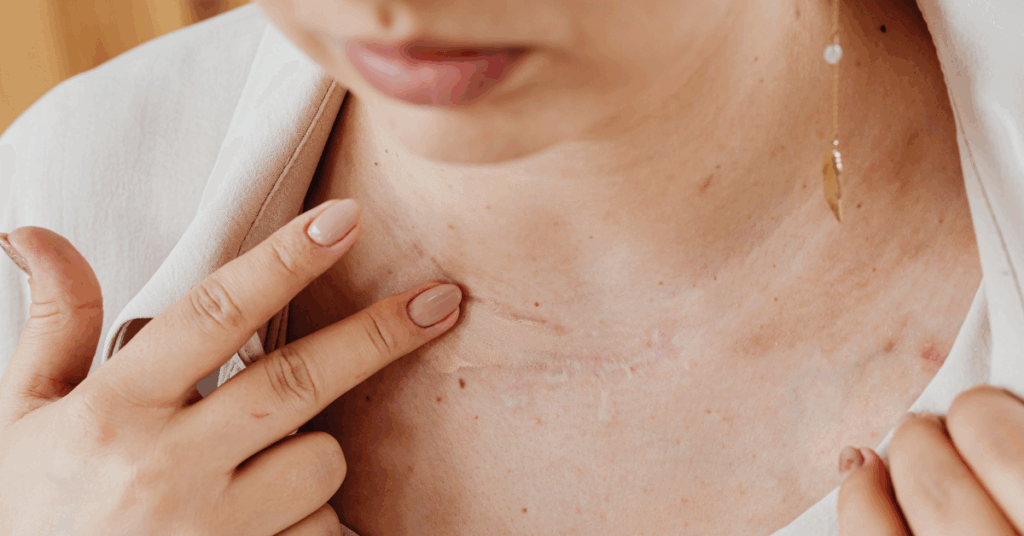
It is not entirely known exactly how many people in the world have scars, but we would guess almost everybody.
In one international survey of around 11 100 adults across several countries, about 48.5% of respondents reported having at least one scar
On a global scale, estimates say that around 100 million people acquire new scars each year. Of course, scars can be caused by burns, surgery, injury, acne, and even disease. Things many of us can easily fall victim to, therefore it should really come as no surprise that it is estimated that 100 mill develop a scar each time the earth rotates around the sun.
The most common type of scar people get is an atrophic scar, especially from acne, and since acne affects nearly everyone at some point, and about 1 in 5 people develop are prone to developing permanent acne scars.
Today, we are spoilt for choice when it comes to helping reduce the appearance of the types of lesions, be it microneedling to laser therapy. But have you heard about scar camouflage?
Scar camouflage treatments, also known as medical tattooing, paramedical micropigmentation, or scar camouflage tattooing, have become an increasingly popular option worldwide.
Let’s learn more about it.
Transforming Scars With Camouflage Tattooing
In short, scar camouflage treatment is a specialised medical tattooing that uses pigments to blend scars with the surrounding skin, making them less noticeable
While traditional cosmetic products can temporarily conceal scars, medical tattooing offers a longer-lasting, more natural-looking solution by blending pigments directly into the scar tissue so that it harmonises with the surrounding skin. This specialised practice sits at the intersection of aesthetics, dermatology, and art, and requires extensive training, precision, and understanding of complex skin conditions.
| Feature Category | Scar Camouflage Tattooing | Normal Tattooing |
| Purpose | Conceal or blend scars with the surrounding skin tone, making them less noticeable. | Artistic expression, decoration, or symbolic design. |
| Target Area | Scar Tissue (often uneven, textured, or discoulored skin). | Intact, healthy skin. |
| Pigment Type | Specialised skin-tone pigments, often custom-matched. | Coloured or black inks for design. |
| Technique | Micro-pigmentation, sometimes with a lighter touch to avoid damaging scar tissue. | Standard tattooing with uniform needle depth and pressure. |
| Required Skill | Highly specialised; understanding of skin tones, scar types, and pigment behaviour. | Artistic skill, design, and standard tattooing technique. |
| Professional Training | Often performed by medical tattooists or trained paramedical tattoo artists. | Standard tattoo artists. |
Scar camouflage tattooing can help reduce the appearance of surgical scars, injury scars, burns, stretch marks, cleft lip repair scars, and scars left behind by medical procedures such as mastectomies.
Each type of scar presents its own challenges. Some scars may be raised or indented, some may have irregular texture, and others may vary in colour from pale white to dark brown or red. While the treatment cannot change the texture of the scar itself, it can dramatically improve the overall visual appearance.
And since, at its core, scar camouflage is a form of micropigmentation, it can also be used for areola restoration after breast surgery, vitiligo camouflage (colour blending in depigmented areas), and scalp micropigmentation (to create the appearance of hair).
Note: Scar camouflage treatment is a type of micropigmentation, but not all micropigmentation is scar camouflage.
Here Is A Closer Look At The Technique
Pigment matching is one of the most important and technical aspects of scar camouflage. Many patients are actually surprised by how complex this step is. Remember, natural skin contains variations in warmth, coolness, and saturation that must be replicated to achieve a believable outcome. Skilled practitioners/medical tattooists often blend multiple pigments, layer colors, or use advanced shading techniques to recreate the multidimensional appearance of skin.
Once the pigment has been created, a fine needle, micro-needle device, or digital micropigmentation device is used to implant the custom-created pigment into the upper dermis of the skin, layer by layer, using controlled, superficial strokes.
Can I Just Opt For A Normal Tattoo Instead?
Sure, many of us may have dreamed about tattooing the Easter bunny over our smallpox vaccination scar (you know, that little dimpled mark on the upper arm). However, ink behaves unpredictably on scar tissue.
This is because scar tissue is denser or thinner than normal skin, which affects how ink settles. As a result, pigment may fade faster, blur, or appear patchy because scar tissue absorbs ink differently. However, yes, it is possible to have a standard tattoo over a scar to help hide it.
Putting It In Perspective
While scar camouflage delivers impressive results for many people, it is important to understand its limitations. The treatment does not erase scars, nor does it physically alter their texture. Instead, it minimises their visual impact.
Despite these factors, many individuals find the treatment life-changing because it helps them feel more comfortable in their own skin. And at the end of the day, that is what it is all about.