

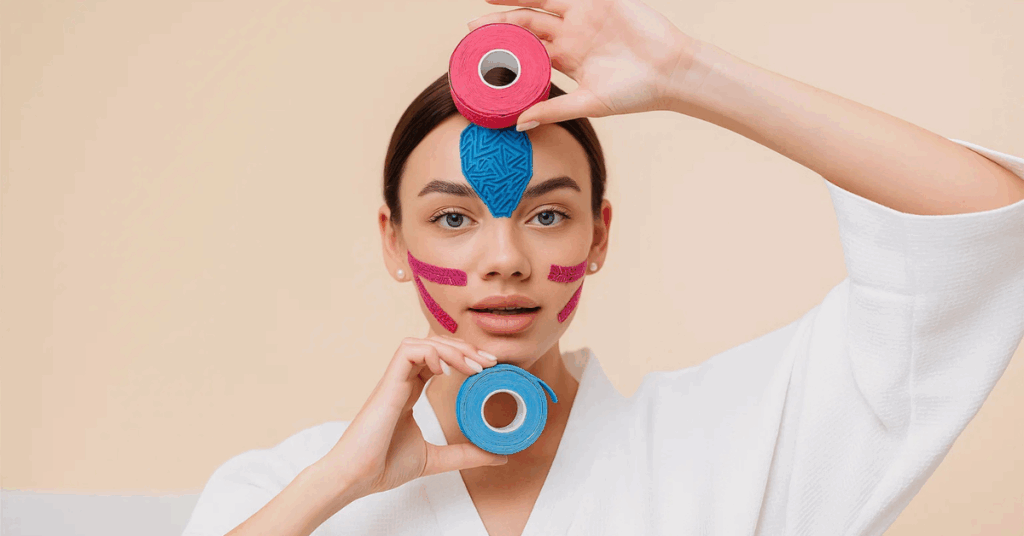
What lengths would you go to for beauty? Would you take the tape you use to wrap birthday gifts for your child’s birthday parties and put this on your face at bedtime, to keep on overnight? You might be skeptical about this, however, social media posts advocating face taping as an aesthetic solution are gaining millions of views.
The beauty hack has emerged as a widely discussed beauty trend across TikTok and Instagram.
The technique involves applying strips of adhesive tape to strategic places on the face and wearing the tape overnight. The idea is to restrict facial movement. Certain social media influencers have advocated this as a cheap and non-invasive way to smooth fine lines and prevent wrinkles.
It sounds convincing… even more so when you watch the sped-up tutorials and time-lapse videos on trending platforms. However, dermatologists and medical professionals are raining on the parade of this ‘too good to be true’ beauty hack. They say that it is an illusion and not a solution. They also have the science to back up their criticism.
What Face Taping Involves
I stand corrected. It is not sticky tape from your children’s birthday party presents used for face taping. It seems there is a finer art to face taping than the obvious. Practitioners use medical-grade tape for their face taping beauty routine. This is placed on the forehead, around the eyes, and by the mouth. The intention is to immobilise facial muscles while sleeping by making it impossible for them to move.
The theory is simple: by limiting muscle movement, you prevent the facial expressions which cause dynamic wrinkles to form.
Some users even wear the tape for a few hours during the day! They hope to ‘train’ their face to stand still.
When I look in the mirror, I see fine lines by my eyes, and the beginning of fine lines just above my nose, between my brows. The first, are from the many smiles I have had through the years. The second from the times I have scrutinised something closely.
I imagine how difficult it would be to ‘tame’ these expressions. Would I want to? I am not so sure. As American comedian Pyllis Diller said: “If you don’t have wrinkles, you haven’t laughed enough.”
A Misunderstanding Of How Wrinkles Form
The aesthetic trend of face taping is often paired with claims of overnight results and long-term wrinkle prevention. Many videos celebrating face taping are tagged, #facetaping and have amassed millions of views. Their popularity is mostly because of their wayward claims. They claim their content can be used for ‘natural ageing’ or ‘clean beauty’ solutions. But what do the experts say?
“Social media thrives on instant gratification,” says Dr Shereene Idriss, a board-certified dermatologist and founder of Idriss Dermatology in New York. “Face taping gives a temporary smoothing effect, but it’s not altering your skin’s biology or preventing wrinkles in a meaningful way.”
Dermatologists argue that the concept behind face taping misrepresents how wrinkles form. While repeated facial expressions do play a role in dynamic wrinkles, they are only one part of the equation. In essence, ageing skin happens for many reasons… you can’t blame the smiles and the frowns. As we age, the skin also loses collagen and elasticity. Taping cannot reverse this.
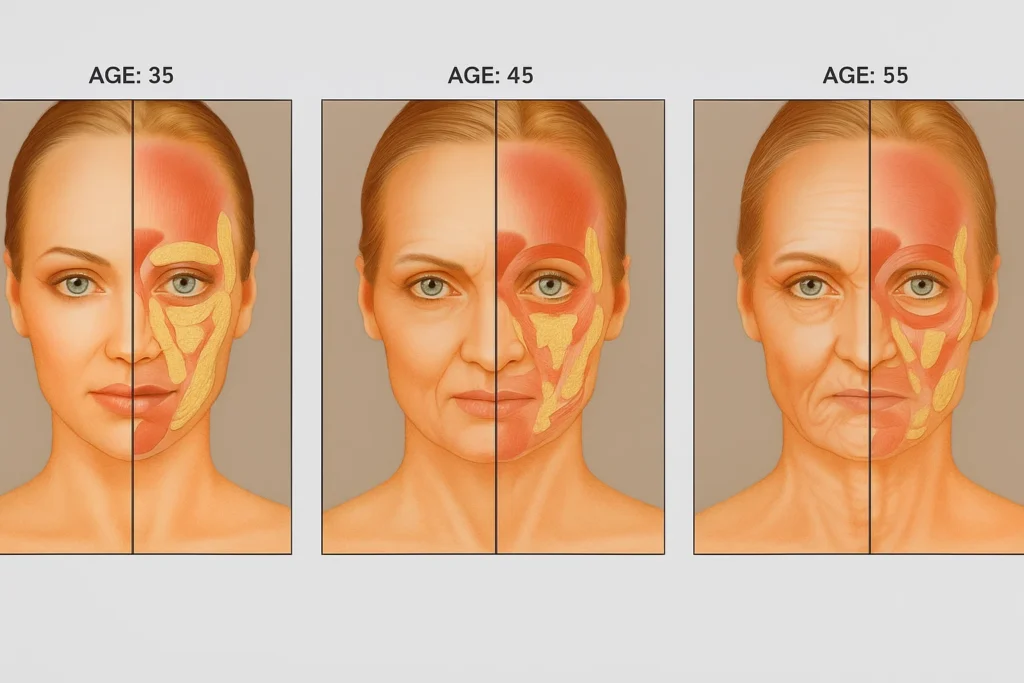
“Facial muscles don’t learn new habits just because you’ve taped them down,” explains Dr Ranella Hirsch, a board-certified dermatologist and former president of the American Society of Cosmetic Dermatology & Aesthetic Surgery. She explains that wrinkle formation is multi-factorial. It can be caused by UV exposure, genetics, skin thickness, and volume loss, among other facts. “Taping addresses none of that,” says Dr Hirsch.
Some experts also caution that the adhesive can irritate or damage the skin barrier, especially in sensitive individuals. “We’ve seen contact dermatitis, allergic reactions, and even tape burns from improper use,” says Dr Corey L. Hartman, founder of Skin Wellness Dermatology in Birmingham, Alabama.
Why The Trend Persists
Even though it is enjoying viral popularity at present, the art of face taping can be traced to the 1920s. Stage and screen actors would use tape and elastic bands hidden beneath wigs or hair to create a lifted, youthful appearance. In fact, old-school ‘facelifts’ with tape were a red-carpet secret long before cosmetic procedures became mainstream.
However, these early face taping methods were intended for a temporary effect for filming purposes. They were not used for long-term wrinkle prevention.
Despite expert warnings, face taping continues to trend. Driving the trend is the dual impact of beauty influencers and the public’s desire for non-invasive, affordable anti-ageing alternatives. The promise of ‘natural beauty’ is becoming increasingly appealing to audiences who desire authenticity above all else.
“There’s a psychological comfort in feeling proactive,” says Dr Anjali Mahto, a London-based consultant dermatologist and author of The Skincare Bible. “Even if it doesn’t work long-term, people feel they’re doing something preventative, and that feeling can be powerful.”