

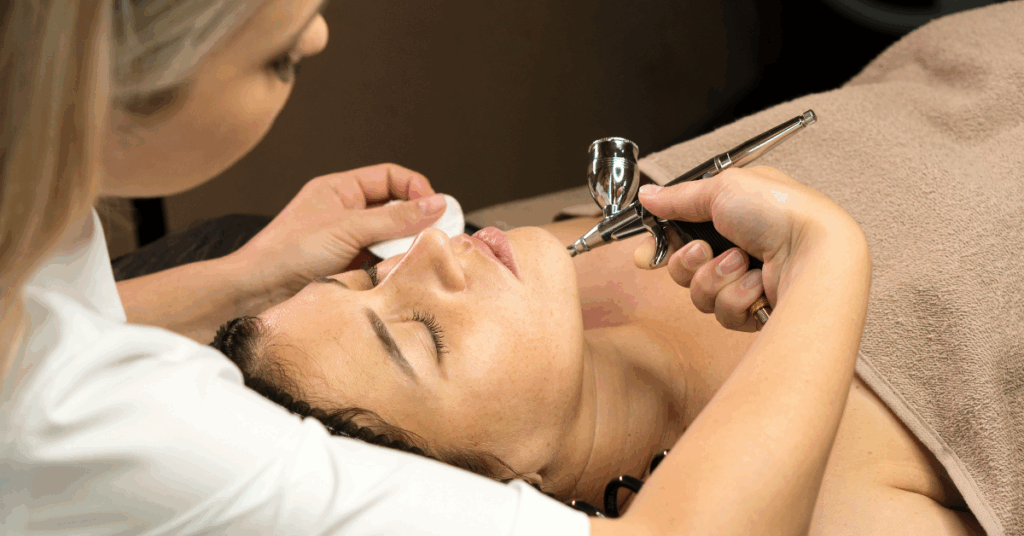
The JetPeel facial has been marketed as ‘microneedling without the needles’. That’s a bold claim to make. As someone who is terrified of needles, this statement immediately caught my attention.
Specifically, I wondered whether it was really possible to do microneedling without the needles. If this were true, we would all be queuing up, right?
When we were growing up, we used to get little plastic make-up sets in the toy stores. You probably still get them and will know exactly the ones I am referring to. You got a tiny eyeshadow container, which appeared to have real eyeshadow, only it didn’t quite give your eye area the colour lift you had hoped for. There was a plastic lipstick with a cherry-red colour which rolled up and down for application purposes. Only, it was plastic so you had to pretend to put it on.
This ‘make-up’ set gave little girls the opportunity to pretend to put on make-up which was a whole lot of fun… however, when you looked in the mirror, your face looked exactly the same.
When I heard of the JetPeel Facial, I wondered whether it would have any real impact using no needles… a bit like the pretend make-up, where after application, you looked in the mirror and your face looked just the same.
The JetPeel treatment promises to rejuvenate skin with zero downtime. For this, it uses air and liquid delivered at jet-engine speeds.
Its growing popularity and its viral sharing online has gathered a lot of critical attention. The critics are asking how effective it really is. Can something so gentle truly rival the collagen-boosting power of microneedling?
The Origins Of The JetPeel Facial
JetPeel was developed by Israeli engineers at TavTech in the early 2000s and is based on aviation technology. It was originally designed to aid in burn wound care. It has since evolved into a skin rejuvenation tool.
It made its way into cosmetic dermatology clinics across Europe before entering the US around 2018.
It uses a two-phase stream of oxygen and liquid microdroplets. These travel at subsonic or supersonic speeds.
This stream is directed onto the skin to exfoliate the surface and infuse ingredients deep into the epidermis. This is all done without physical contact.
The treatment offers a pain-free, needle-free way to deliver active ingredients like hyaluronic acid, vitamins A, C, E, peptides, and growth factors directly into the skin.
Its unique ability to penetrate as deep as 4mm into the dermis without a single puncture has led to its comparison to microneedling.
Is It Really Microneedling Without The Needle?
It’s easy to understand why JetPeel has been likened to microneedling. Both aim to stimulate collagen, improve skin texture, reduce signs of ageing, and enhance product absorption.
The key difference lies in the mechanism. Microneedling relies on creating thousands of micro-injuries in the skin using tiny needles. These prompt the body’s natural wound healing response and collagen remodelling.
JetPeel bypasses this trauma-based approach by opening microchannels through pressurised delivery, thereby avoiding inflammation and physical injury.
“JetPeel does offer some mild stimulation of the dermis and can improve hydration, brightness, and superficial texture,” explains Dr Julia Tzu, a board-certified dermatologist and founder of Wall Street Dermatology. “However, for deeper issues like acne scarring or severe wrinkles, microneedling still has the upper hand.”
Studies published on PubMed and ResearchGate show promising results for JetPeel in improving skin glow, texture, and hydration. A study of 50 patients concluded that JetPeel was safe and effective for superficial resurfacing, especially around the mouth. But researchers noted the need for further evidence to support its use in deep tissue remodeling or long-term anti-ageing.
The most immediate benefit of JetPeel is a radiant, dewy glow which appears right after the treatment. Skin feels refreshed, looks plumper, and appears more even-toned. For these reasons, it’s often dubbed the ‘Red Carpet Facial’.
It is ideal for application before weddings, photoshoots, or special events. Multiple treatments are recommended for cumulative benefits.
Microneedling, by comparison, doesn’t offer the same instant visual payoff. Redness and minor inflammation are common in the days following treatment, and it takes a few weeks for collagen production to kick in. However, the long-term effects are typically more dramatic and long-lasting. These include skin texture, tighter pores, reduced acne scars, and fewer fine lines.
“Microneedling has more scientific literature backing its efficacy in structural skin remodeling,” says Dr Michael Gold, a dermatologic surgeon based in Nashville. “It’s particularly effective for deeper dermal issues, whereas JetPeel is more of a surface-level, nourishing treatment.”
Dermatologists’ Verdict On JetPeel
JetPeel isn’t without merit. You will notice a difference when you look at your face in the mirror afterwards, says the experts.
Dermatologists who offer it often praise its ability to hydrate, brighten, and calm the skin with no risk of bruising or downtime. Dr Mona Gohara, a Yale-affiliated dermatologist, notes, “It’s painless, pleasant, and enhances glow. But I wouldn’t recommend it as a replacement for microneedling if someone is targeting deep acne scars or serious collagen loss.”
On the other hand, some dermatologists remain skeptical of its comparison to more intensive treatments. “Calling it microneedling without the needle is more of a marketing term than a clinical reality,” says Dr Evan Rieder, a double board-certified dermatologist and psychiatrist. “It may help with hydration and mild exfoliation, but it’s unlikely to achieve the collagen-inducing effects of actual microneedling.”
Still, it seems JetPeel fills an important niche. It offers instant gratification, comfort, and visible brightness, without irritation or pain. It’s an attractive option when prepping for a big event or looking to maintain skin health between more intense procedures.
However, when it comes to long-term collagen production, dermal remodeling, and treating deeper skin concerns, microneedling still leads the pack.