
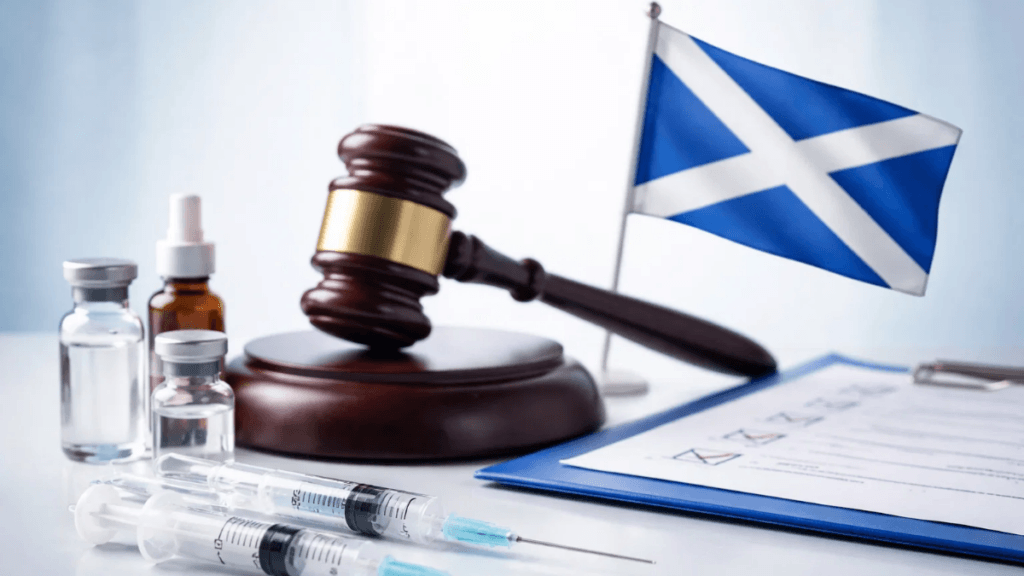
The aesthetics industry has spent the better part of a decade expanding faster than its own rules. In that time, non-surgical procedures have moved from the margins of private medicine into the mainstream of consumer culture, accessible, visible, and increasingly normalised. What has not kept pace is the framework governing how, where, and by whom those procedures are carried out. Scotland’s proposed legislation marks a decisive attempt to close that gap.
The Non-surgical Procedures and Functions of Medical Reviewers Bill (Scotland) is, on the surface, a piece of technical legislation. In practice, it represents a fundamental repositioning of aesthetic medicine. From a loosely regulated service category into something far closer to a controlled, healthcare-adjacent discipline. For consumers, that shift will be felt in safety and access. For practitioners, it will redefine the structure of the market itself.
At the heart of the bill is a simple premise, that procedures which pierce or penetrate the skin, even when undertaken for cosmetic rather than medical reasons, carry risks that justify oversight. This may seem self-evident, yet until now, the regulatory approach across much of the UK has been inconsistent at best. The same injectable treatment could be delivered in a clinical setting by a medically trained practitioner, or in an informal environment with minimal oversight. The outcome, unsurprisingly, has been variable.
The legislation introduces a clearer boundary. Non-surgical procedures are formally defined, not as an abstract category but as a regulated activity. That alone is significant. It brings a wide range of treatments, such as injectables, advanced skin interventions, and certain energy-based procedures, into a shared legal framework. The ambiguity that has long allowed the industry to operate in parallel with regulation begins to narrow.
One of the most immediate and unambiguous measures is the prohibition of such procedures for individuals under the age of 18. This is less a controversial move than a codification of what many would argue should already be standard practice. Yet the distinction lies in enforcement. What was previously guidance becomes law, removing discretion from providers and introducing clear legal consequences for non-compliance.
More consequential, however, is the requirement that procedures be carried out only within approved premises. This is where the practical impact becomes apparent. A sector that has tolerated a wide range of operating environments, from fully equipped clinics to domestic settings, will now be anchored to spaces that meet defined standards. Hygiene, safety, and accountability become inspectable rather than assumed.
For many established clinics, this will feel like a natural extension of existing practice. For others, it represents a structural barrier. The days of informal or semi-formal provision, while not disappearing overnight, are clearly numbered. The industry is being nudged toward consolidation, where fewer providers operate within tighter parameters.
Perhaps the most strategically important element of the bill is not what it enforces immediately, but what it enables in the future. The legislation creates a framework through which the Scottish Government can later define who is qualified to perform which procedures. At present, that question remains only partially answered. The bill does not impose a rigid hierarchy of practitioners, but it lays the groundwork for one.
Before the clinical and ethical implications are even considered, the economic consequences of this legislation are likely to be immediate and unevenly distributed. By raising the threshold for compliance, through requirements around premises, governance, and eventual practitioner qualification, the bill effectively increases the cost of operating within the sector. For smaller, non-medical providers who have historically relied on low overheads and flexible setups, that shift may prove prohibitive, forcing a number of operators to exit the market altogether.
In parallel, established clinics with existing infrastructure and medical oversight are likely to consolidate their position, benefiting from reduced competition and increased consumer trust. The result is a gradual rebalancing of the industry with fewer providers, higher average standards, and a redistribution of revenue toward those able to meet regulatory expectations. In the short term, this may tighten access and increase pricing pressure; in the longer term, it is likely to create a more stable, investable market with clearer barriers to entry.
This is where the direction of travel becomes clear. Over time, the expectation is that qualifications, training pathways, and scope of practice will be more tightly controlled. The implications for non-medical practitioners are significant. So too are the implications for medically-led clinics, which may find their existing structures increasingly aligned with regulatory expectations.
Enforcement, often the weakest link in previous attempts at regulation, is addressed more directly here. Authorities are granted powers to inspect premises, investigate activity, and, where necessary, seize evidence. Penalties for non-compliance are not symbolic. They introduce a level of accountability that the sector has, until now, largely avoided.
For patients, the changes are likely to manifest gradually rather than dramatically. There will be fewer providers operating at the margins, and a greater expectation that consultations are structured, documented, and clinically justified. Access may narrow slightly, but consistency is likely to improve. The experience of aesthetic treatment may begin to resemble that of other areas of private healthcare. It will be less transactional and more procedural.
For practitioners, the adjustment is more immediate. Compliance carries cost. Premises must meet standards, processes must be formalised, and decision-making becomes more visible. Yet within that pressure lies an opportunity. As barriers to entry rise, the competitive landscape shifts. Clinics that have built their models around governance, patient safety, and long-term outcomes are unlikely to be disadvantaged. If anything, they are positioned to benefit from a system that increasingly rewards those attributes.
The broader significance of the bill lies beyond Scotland. It is difficult to view this legislation in isolation. The same concerns, patient safety, inconsistent standards and reputational risk, exist across the UK. Should the Scottish framework prove effective, it is unlikely to remain geographically contained. Similar approaches in England and elsewhere would not be surprising.
What emerges, then, is not simply a regulatory update, but a signal of intent. Aesthetic medicine is being reclassified, not in name but in expectation. It is no longer sufficient to operate as a loosely defined service layered on top of consumer demand. The direction is toward structure, accountability, and a more formalised relationship with healthcare.
Community Feedback
We asked Flavio Refrigeri, an established healthcare professional and founder of Fiore Aesthetics for his opinion on this new law:
I’m genuinely very pleased to see the Scottish Government taking this important step towards regulating the aesthetic medical sector. For too long, this industry has operated in a grey area, and this move represents real progress in protecting patients and elevating professional standards. What I particularly welcome is that this is not about excluding practitioners without a traditional healthcare background or creating a divide between “medics” and “non-medics.” Instead, it’s about raising the bar for everyone, ensuring that all practitioners, regardless of their starting point, meet robust, government-recognised standards of education, training, and clinical competence.
From my perspective as a practitioner and educator, this is exactly the direction we need. A regulated framework brings clarity, accountability, and ultimately safer outcomes for patients. It reinforces the idea that aesthetic treatments are medical in nature and should be approached with the same level of responsibility, governance, and ongoing education. I truly hope this is just the beginning and that the rest of the UK will follow Scotland’s lead in implementing a consistent, nationwide licensing system. This is not a war between medics and non-medics, it’s a collective step forward towards a more professional, ethical, and trusted industry, where patient safety and high standards are at the centre of everything we do.
British model, television presenter, and qualified skin therapist, Gabrielle Richens said:
This Bill is a massive win for patient safety in Scotland. It draws a clear line between everyday beauty treatments and medical-grade procedures, finally shutting down unqualified ‘cosmetic cowboys’. With proper clinical settings and training standards, it’ll protect young people and vulnerable clients while backing ethical practitioners already working safely. Raising the bar is how we build a truly transparent, caring aesthetics industry, I really hope the rest of the UK follows suit soon!
For an industry that has thrived on speed and visibility, this represents a recalibration. Growth will not disappear, but it may become more measured. The emphasis shifts from expansion to consolidation, from access to assurance.
There is a tendency to frame regulation as restriction. In this case, it may be more accurate to see it as maturation. The market is being asked to meet the standards that its own evolution has made necessary. The outcome, if implemented effectively, is unlikely to be a smaller industry, but a more stable one, operating on terms that are clearer for both those who provide treatments and those who receive them.