

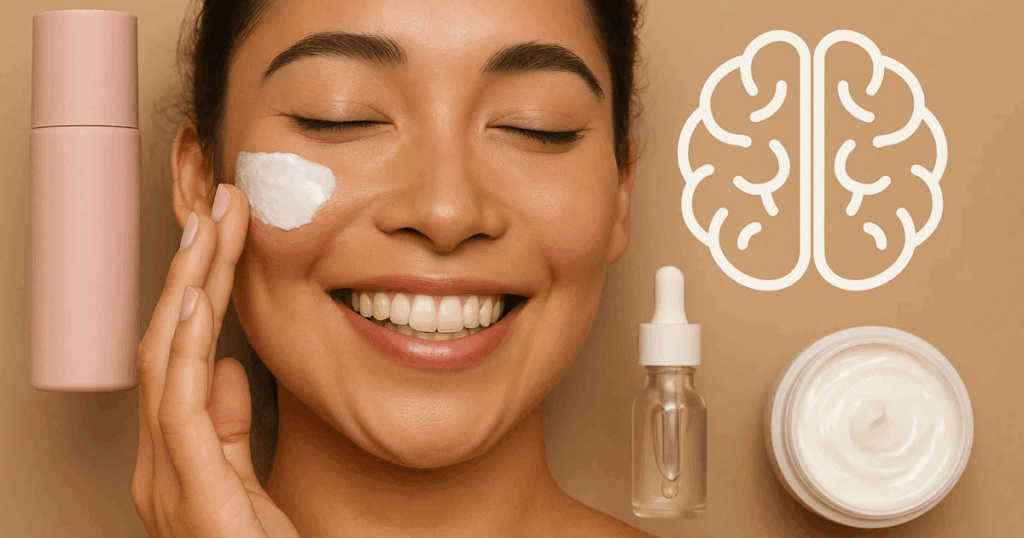
The beauty industry is constantly evolving and a new beauty trend, now popular among A-list celebrities, has taken centre stage. The trend is focused on products which help you to feel good as well as look good. These are called ‘neurocosmetics’.
Neurocosmetics are formulated taking the neurological responses of the user into consideration, through combining skincare with neuroscience. These innovative products do not just sit on the skin’s surface. They are designed to stimulate or modulate neurological responses which are linked to the sensations of comfort, stress, pleasure, and even mood.
This means when you apply them, you are theoretically giving both your face, and your mood a make-over! The reason they are able to impact the nervous system is because they contain ingredients which can influence cortisol levels and even mimic endorphins. Endorphins are your feel-good hormones.
The rationale behind these products is that people no longer just want to look better but also to feel better. Neurocosmetics may be the vehicle to bridge both. Senior consultant at Mintel Consulting, Vivienne Rudd, explains that neurocosmetics and its close cousin, psychodermatology, are now gaining momentum after years of slow progress. This means that the science behind them is nothing new. However, it is only now stealing the spotlight.
“Neuroscience and psychodermatology have been passions for me for at least six years and it’s been a little frustrating to see the slow progress of both. However, the last year has witnessed an acceleration of available technologies and product activations will inevitably catch up.”
— Vivienne Rudd
The reason that neurocosmetics are suddenly making headlines is because of scientific advances in the understanding of skin-brain communication pathways, and an increase in consumer interest in multi-functional wellness products. Modern life has also become more stressful. As a result people are demanding products which facilitate de-stressing, and which have mood-enhancing functions.
According to Rudd, nutricosmetics are also gaining prominence. These are ingestible supplements which work in tandem with topical neurocosmetics to target mood, skin health, and hormonal balance.
A-List Celebs Seek Beauty Options Which Are More Than Skin-Deep
International stars are among those punting the new range of beauty innovations, with models and celebrities helping to bring neurocosmetics into the mainstream media.
Model and entrepreneur Miranda Kerr has publicly spoken about the emotional side of skincare, advocating for rituals which promote mindfulness and calm. Her organic skincare line, KORA Organics, recently introduced products infused with gemstones and aromatherapy oils. These are designed to both uplift the spirit and nourish the skin.
Then there’s pop icon Selena Gomez, whose Rare Beauty line prioritises emotional wellness and mental health. She has hinted at future collaborations involving wellness-infused beauty.
“How we feel is just as important as how we look.”
— Selena Gomez
On TikTok and X, beauty influencers are reviewing products which promise to soothe the nervous system, stimulate skin-to-brain signaling, and reduce stress through skincare.
The language of mental health and neuroscience is now being woven seamlessly into beauty marketing. It seems this is exactly what consumers are longing for.
Here Are Some Of The Key Ingredients Found In Neurocosmetics:
- 1 Neurotransmitter-Mimicking Actives
Ingredients such as palmitoyl tetrapeptide-7 or beta-endorphin-like peptides are used to mimic the effect of feel-good chemicals, such as serotonin and dopamine. They help to create a sense of relaxation and pleasure. - 2 Anti-Stress Compounds
Adaptogens such as ashwagandha, ginseng, or centella asiatica are included to counter the effects of cortisol, the stress hormone. These soothe the skin and are believed to help calm the nervous system. - 3 Sensorial Stimulation
Textures, scents, and temperatures play a huge role in the formulation of neurocosmetics. Formulae may include warming or cooling agents, essential oils, and textures designed to activate the sensory nerves in the skin. - 4 Neuroactive Supplements
Some brands are integrating oral supplements to support skin-brain health from the inside out, combining skincare with the philosophy of ‘beauty from within.’
What We Now Know
While neurocosmetics hold immense promise, experts have cautioned that the category must be approached with scientific integrity.
“Any brand looking to move into these areas must be fully aware of the needs and hesitations of consumers and must ensure that their claims are substantiated if they are to avoid accusations of wellness-washing and scientific romance.”
— Vivienne Rudd
This means that thorough testing, peer-reviewed studies, and honest marketing will be crucial as the category grows. It is always advisable to first check with a medical or health professional before starting to use any new cosmetic or beauty product.
Still, experts have predicted that neurocosmetics might soon become a core pillar in the beauty and wellness industries.
Meanwhile, Selena Gomez continues to champion striving to feel good, in addition to looking good. In considering how her body had changed between pictures of herself in a swimsuit taken in 2013 and then later, in 2023, she wrote on her Instagram page, beneath the older bikini photo:
“Today, I realised I will never look like this again. I’m not perfect but I am proud to be who I am … sometimes I forget it’s OK to be me.”
— Selena Gomez
This new range of cosmetics is penetrating the heart of the industry to become a trend which is more than just skin-deep. Whatever the future holds, what remains intriguing, is the connection that exists between our emotional state and our skin health.