

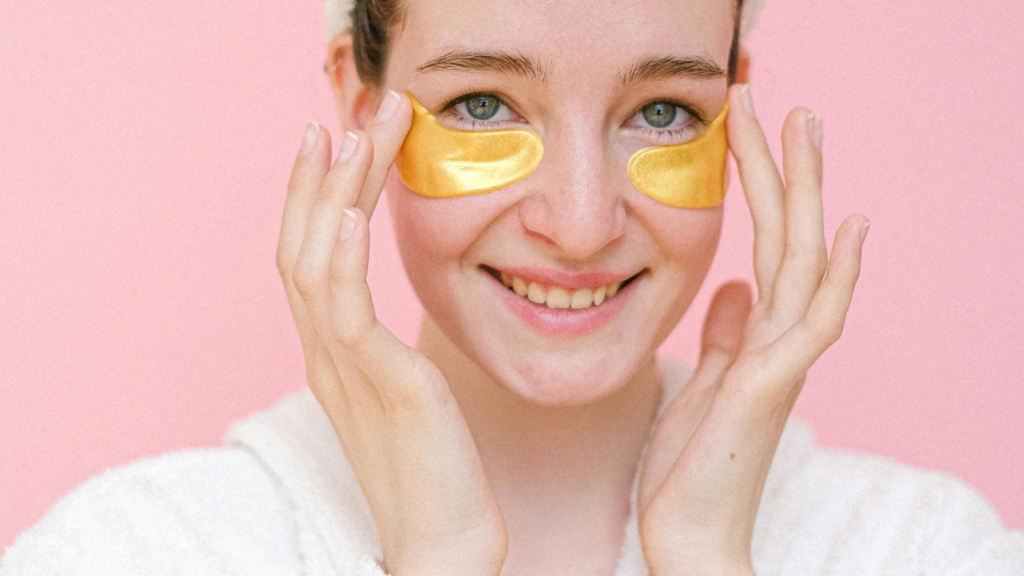
Eye patches are enjoying a surge in popularity on TikTok. The beauty trend tracker, Submarine.ai has reportedly recorded an extraordinary 18,559% week-on-week increase in views, making it one of the fastest-rising beauty topics on the platform.
Influencers are applying little crescent-shaped eye patches strategically under their eyes while making their morning coffee and celebrities are wearing them before red-carpet appearances!
The message on social media seems to be that you can stick on two patches, wait 10 to 20 minutes and emerge looking fresher, brighter and less tired.
Could this be too good to be true?
My experience with ‘eye patches’ has been limited to cool cucumber slices placed over my eyes, usually at girly get-togethers where we paint our nails and enjoy feeling beautiful.
However, could there be scientific verification behind this latest trend?
In my questioning I discovered that under-eye patches are hardly new. Hydrogel masks have been a staple of Asian beauty routines for years, while eye masks have long been marketed as an express solution for dehydration, puffiness and tired-looking eyes.
What has changed is the way the product is presented. The eye patches on TikTok are highly visual. They are instantly recognisable in a TikTok or Instagram video and require very little explanation.
The wearer simply applies the patches, carries on with their routine and then removes them to reveal the supposed transformation.
There is also a strong ‘self-care’ component. Applying eye patches can turn an ordinary skincare routine into a ritual, particularly when the patches are chilled in the refrigerator and used first thing in the morning.
Unlike many complicated skincare routines, the appeal is also immediate. Consumers do not have to wait weeks to decide whether the product is working.
However, the question is whether the immediate effect is skincare science or simply skincare theatre. These are important questions to ask, since there is a lot of smoke and mirrors, as well as hearsay, on social media.
Researchers explain that there is some science behind the popularity.
Let me explain…
Eye patches create an occlusive layer over the skin. This can reduce water loss from the surface of the skin and keep hydrating ingredients in contact with it for longer.
This has an ‘occlusive effect’ according to dermatologists. Essentially, this means that the patches can temporarily increase hydration.
Ingredients commonly found in eye patches include humectants such as glycerin and hyaluronic acid, which help attract and retain water.
The physical patch also prevents the product underneath from evaporating as quickly as it might from an ordinary cream or serum.
The skin in the periorbital area is relatively thin and can become visibly dehydrated, making fine lines appear more pronounced. Increasing the water content of the outer layer of the skin can temporarily make it look smoother and more plump.
So the patches are not necessarily doing nothing.
Still, expectations around eye patches need to be more realistic. Under-eye puffiness has multiple causes. Lack of sleep, fluid retention, allergies, genetics, ageing and the anatomy of the area around the eye can all contribute.
A topical patch cannot permanently remove an anatomical fat pad or reverse the underlying cause of chronic under-eye bags.
It can, however, make the area look temporarily less puffy.
Another explanation for the impact of eye patches comes from cooling. Chilled patches can produce a refreshing sensation and may temporarily constrict blood vessels. The physical presence of the patch may also create a mild compressive effect.
This helps explain why the ‘before and after’ images on social media can look surprisingly convincing.
However, it is generally a temporary cosmetic effect rather than a structural change.
The ingredient list also matters. Not all eye patches are created equal. The patch itself is only one part of the formula. What it delivers to the skin is equally important.
For hydration, ingredients such as hyaluronic acid and glycerin are common choices. Caffeine is frequently included in products marketed for puffiness and tired-looking eyes, while peptides and antioxidants are often used in products positioned around fine lines and skin ageing.
The formulation also matters because the eye area can be particularly sensitive. A product containing fragrance, essential oils or other potentially irritating ingredients may not be suitable for everyone, particularly if it migrates towards the eyes.
Dermatologists interviewed by TODAY have described eye patches as an occlusive delivery system that can enhance contact between active ingredients and the skin.
But what about wrinkles and dark circles?
This is where viral beauty claims can run ahead of the evidence. Hydration can make fine dehydration lines appear less obvious, which may create the impression that wrinkles have been ‘erased’. However, this is not the same as reversing established wrinkles.
Similarly, dark circles are notoriously difficult to treat because they do not have one single cause.
Pigmentation, visible blood vessels, shadows created by facial anatomy, thinning skin and tear-trough volume loss can all contribute.
A moisturising patch is unlikely to address all of these mechanisms.
Our verdict?
The science suggests that eye patches can have a genuine skincare effect, particularly around hydration and temporary puffiness. However, the viral transformation is likely to be considerably bigger than the long-term biological one.