

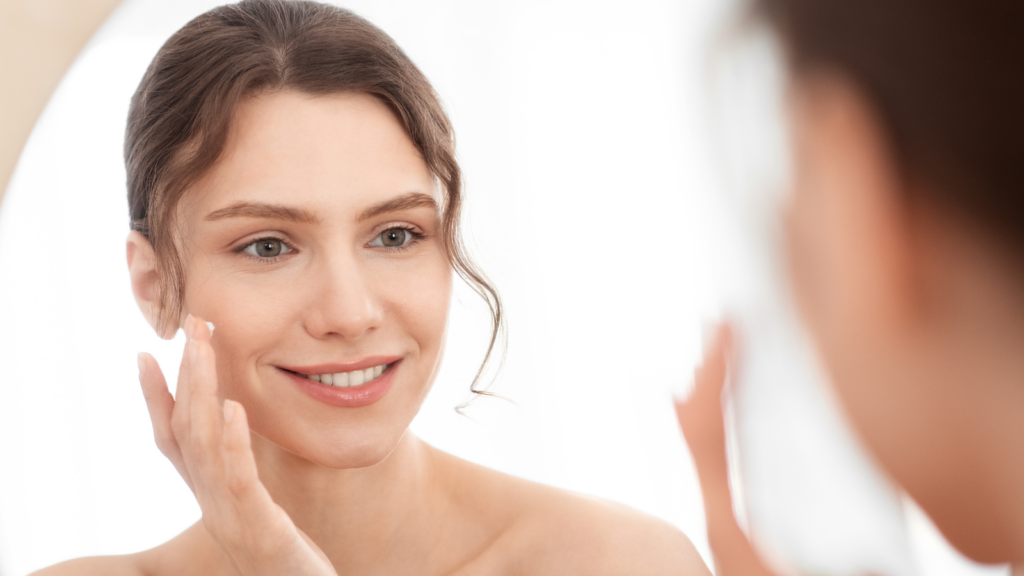
For years, facial hair has been something women were encouraged to hide. However, as beauty standards have become more nuanced, ‘peach fuzz’ is again a topic of conversation.
The face is covered in tiny hairs. These are not necessarily unwanted hair. These vellus hairs are commonly known as peach fuzz, and they are a completely normal feature of human skin. Vellus hair covers much of the body and has functions including helping with temperature regulation and sensation.
However, beauty culture has a complicated relationship with them. Filters erase them. High-definition cameras reveal them. Make-up can catch on them. More increasingly, people are asking whether removing them could create a smoother, more luminous complexion.
No Filter Clinic in London offers a treatment called Dermaplaning as a way of getting rid of excessive peach fuzz. The treatment is designed to remove fine vellus hair and dead skin cells, revealing a smoother, more radiant-looking surface.
The clinic describes the treatment as producing instant results with no downtime.
Peach Fuzz Isn’t The Enemy
The first thing worth knowing about facial hair is that there is nothing inherently wrong with having it.
Vellus hair is different from terminal hair; the thicker, darker hair which is found on areas such as the scalp, underarms and, in many people, parts of the face. Its colour, thickness and length vary naturally from person to person.
So why does it suddenly seem so noticeable?
Part of the answer may be technology. Smartphone cameras, high-resolution photography, ring lights and magnifying mirrors expose details of the skin which previous generations rarely scrutinised. Social media filters then create the opposite effect, smoothing away texture, pores and hair.
The result is an increasingly strange beauty paradox: we are seeing more of our real skin while simultaneously becoming accustomed to seeing digitally perfected skin.
Dermaplaning offers one way of physically changing the skin’s surface. However, it should not be confused with permanently changing the hair itself.
The treatment cuts the hair at or near the skin’s surface. It does not alter the hair follicle or fundamentally change the biological characteristics which determine how the hair grows.
Medical sources consistently describe the idea that shaving or dermaplaning makes hair grow back darker or thicker as a myth.
There is, however, a reason people believe it. A naturally growing hair has a tapered end. When it is cut, the new end is blunt. As it begins to grow back, that blunt edge can temporarily feel more noticeable or slightly rougher. The hair itself has not magically become thicker. It has simply been cut.
The Process Of Dermaplaning
Dermaplaning is a superficial exfoliation treatment that uses a blade to remove dead cells from the skin’s outermost layer while simultaneously removing vellus hair.
That means the ‘peach fuzz’ effect is only part of the story.
The treatment is essentially doing two jobs at once, namely hair removal and exfoliation.
Removing the fine hair can create a smoother surface, while removing accumulated dead skin cells can make the complexion appear fresher and brighter. Professional dermaplaning is also associated with a smoother-feeling skin surface and can provide a more even canvas for makeup.
This is why calling dermaplaning simply ‘face shaving’ misses an important part of the treatment.
Why Professional Treatment Matters
The popularity of dermaplaning has inevitably led to the rise of DIY facial razors.
However, there is an important difference between running a small cosmetic razor over the face and having professional dermaplaning performed with appropriate technique and hygiene.
The skin barrier is not indestructible. Excessive exfoliation can produce irritation, dryness and sensitivity, while poorly performed treatments can cause cuts, inflammation or infection.
Professional assessment also matters because not every skin concern should be treated by scraping the surface.
Active inflammatory acne, irritated skin, certain infections and some other skin conditions may make dermaplaning inappropriate or something that should be postponed.
This is one reason the treatment should be approached as an aesthetic skin procedure, rather than simply an upgraded version of shaving.
The Make-Up Effect
One of the reasons dermaplaning has become popular is what happens after the treatment.
Fine facial hair can create a subtle layer between the skin and make-up. Removing it creates a very smooth surface, which may make foundation and other complexion products appear more seamless.
For anyone preparing for photography, an event or simply wanting makeup to sit differently on the skin, that can be particularly appealing.
There is also a visual phenomenon at play. When light encounters a surface covered in fine hairs and uneven dead skin cells, it is scattered in different directions. A smoother surface can reflect light more evenly, contributing to the impression of brightness.
The result isn’t necessarily ‘new skin’ but a smoother optical canvas.
Dermaplaning can improve the feel and appearance of superficial skin texture, but it is not a miracle treatment for deep wrinkles, significant skin laxity or every type of acne scarring. It works primarily at the surface. Nor does it permanently remove facial hair. The vellus hair will grow back because the follicles remain intact.
This makes dermaplaning fundamentally different from treatments designed to permanently reduce hair growth.
It also means the treatment can be viewed less as a once-and-done transformation and more as part of an ongoing skin-maintenance approach.