

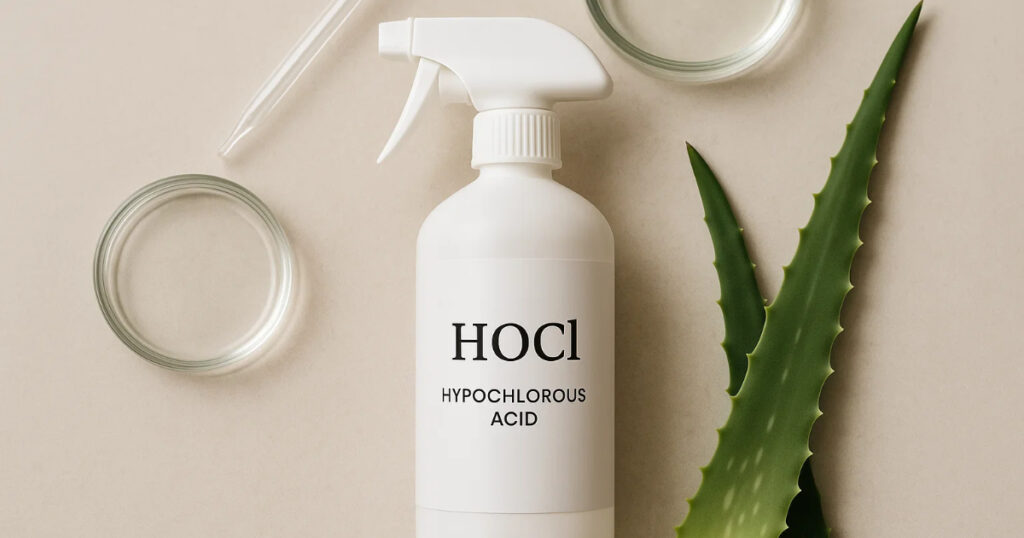
The world is constantly hungry for new, natural, and science-backed solutions. It is into this arena that Hypochlorous Acid (HOCI) sprays have emerged as one of the most surprising skincare heroes.
“The interest in hypochlorous acid’s benefits has only been growing, with it now becoming one of the latest buzzwords in skincare,” says Harpers Bazaar, explaining the spray’s benefits online.
This clear, odourless solution was once only known to medics and microbiologists. Now it is being misted over faces by dermatologists, influencers, and acne-prone teens.
This means that while it was once strictly used to fight pathogens, it is now fighting pimples. We can all remember being teenagers and fretting over each new pimple on our face. The promise of a spray which can be a part of the solution for this teenage angst seems almost too good to be true.
You might just see a pimple on a teenager’s face. However, to that teenager, that pimple might feel like the loss of social dignity, a mountain rather than a molehill, and a catastrophic disaster of unprecedented proportions. This is one of the reasons a spray which offers acne relief is trending on platforms which Gen Z frequents.
Board-certified dermatologist Dr Marisa Garshick, says of the spray: “Because it helps to repair the skin, it can be used to treat all skin concerns, strengthen and soothe the skin as it can help to reduce redness and inflammation as well as skin sensitivity.”
Hypochlorous Acid is a molecule naturally produced by the human immune system. It is generated by white blood cells when the body is responding to injury or infection. Its job is to kill bacteria, viruses, and fungi quickly and efficiently. It does this without damaging healthy cells.
According to Dr Elizabeth Hale, a board-certified dermatologist and senior vice president of the Skin Cancer Foundation: “HOCl is a powerhouse antimicrobial agent that mimics a natural part of our immune response. It’s extremely effective and incredibly gentle, which makes it ideal for skin use.”
Today, Hypochlorous Acid is synthesised in labs through a process called electrolysis. This involves passing an electrical current through a saltwater solution. This creates a stable version of HOCl which can then be bottled, stored, and safely applied to skin.
The Journey Of A Transformative Substance
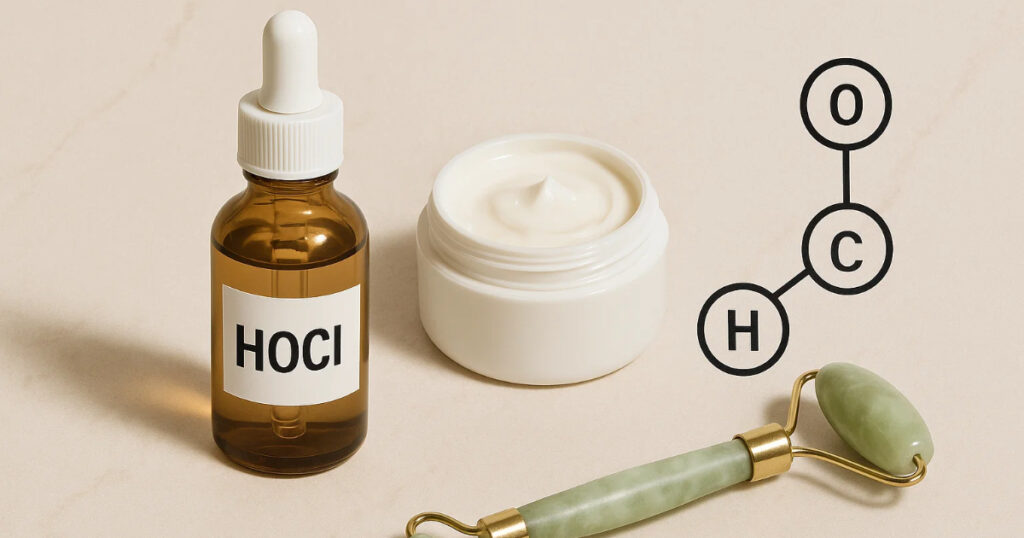
Hypochlorous Acid isn’t new. It has been used for decades in hospitals to clean wounds and prevent infection. During World War I, it was used to sterilise wounds and surgical instruments.
It later gained more traction in medical settings and was started to be used for the treatment of diabetic ulcers, burns, and post-operative recovery.
Its safety profile has been well-documented. It doesn’t sting or damage tissue, and doesn’t promote resistance like antibiotics.
You might wonder then how it made a notable leap into the realm of skincare. This actually happened quite by accident. Doctors noticed that patients being treated with HOCl for surgical recovery or chronic wounds often showed unexpectedly fast healing of the surrounding skin, reduced inflammation, and fewer breakouts.
As a result, researchers began to explore whether this gentle but potent molecule could be used more broadly for cosmetic and dermatological purposes.
Clinical studies in journals like Dermatologic Surgery and Journal of Cosmetic Dermatology show that HOCI sprays reduce acne-causing bacteria, soothe eczema flare-ups, calm rosacea, and improve post-procedure healing after microneedling, lasers, and chemical peels.
Its anti-inflammatory and antimicrobial properties are celebrated for alleviating common skin issues.
HOCl sprays are widely used to treat a variety of skin concerns. These include acne, dermatitis, eczema, rosacea, and sensitivity after cosmetic procedures. It’s also found a place in managing maskne. This is acne and irritation caused by prolonged mask use. It is a condition which saw a surge during the COVID-19 pandemic.
Dr Whitney Bowe, a board-certified dermatologist and media contributor, praises it for being gentle enough to use multiple times a day, yet powerful enough to kill the bacteria which worsen inflammatory conditions.
Who Uses It Now?
The current user base for HOCI spans generations and skin types. Teenagers with acne, adults battling stress-induced breakouts, patients recovering from cosmetic treatments, and even infants with eczema all benefit from its effects.
Interestingly, dermatologists have also started recommending HOCl sprays for non-facial applications, such as underarm irritation, ingrown hairs, and minor scrapes and burns.
Since it’s so safe, some people even use it around the eyes to clean eyelids.
One of the most fascinating aspects of this transformative substance is how effectively it mimics the body’s own healing process. While most skincare ingredients are synthetic or plant-derived, HOCl is one of the few that is biologically identical to a molecule we already produce.
Some researchers are now investigating whether HOCl could play a role in managing antibiotic-resistant infections, due to its broad-spectrum antimicrobial capabilities. Others are studying how it could be combined with growth factors or peptides to enhance regenerative healing for ageing or injured skin.
While there is still so much to discover about HOCI, it stands out for its simplicity iIn a crowded beauty market. We also love it for the fact that it works with the body, and not against it. As Dr Hale explains: “Sometimes the best solutions are the ones nature gave us to begin with.”