

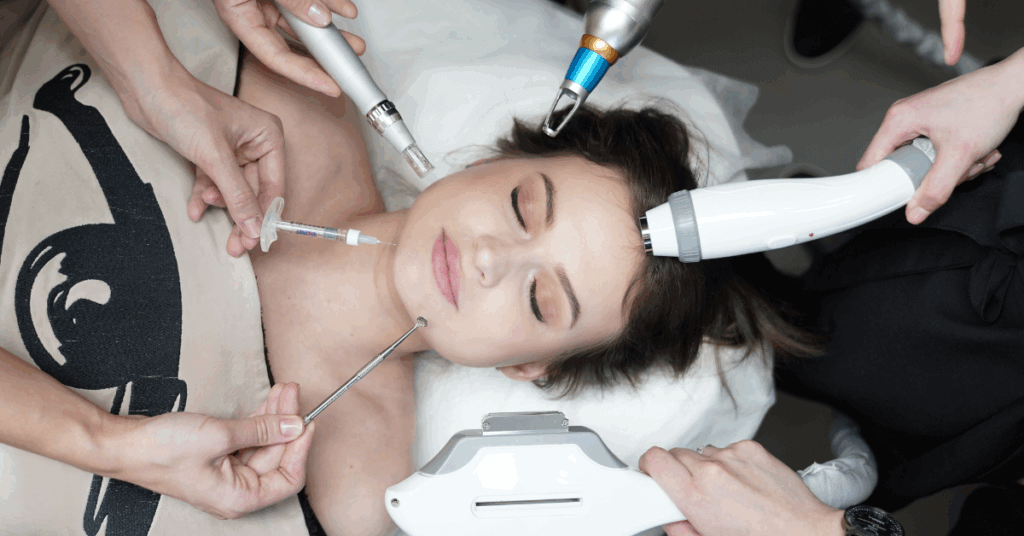
Walk down any London high street and you’ll find aesthetics clinics buzzing with clients and shelves stacked with serums promising miracles. Even online this ‘madness’, if you could call it that, continues… TikTok tutorials preach about seven-step exfoliation routines, and a new at-home device crops up on Instagram feeds every week.
To be honest, I find this quite overwhelming. From hydrafacials to injectables, there are so many treatments and options out there. However, I was brought up to appreciate simple routines and so through all the noise of promised benefits and revolutionary new treatments, I find myself asking many questions.
One of these: “How much is too much?”
Perhaps you have also asked it too. I have often questioned where the line between ‘disciplined’ and ‘going overboard’ is with regards to beauty routines.
I read a quote by a skin specialist, Tarryn Warren, in a Vogue article. She spoke about the overuse of products by her clients and the result this was having on their skin, saying: “Particularly after lockdown, there has been more overtreated skin, and when I ask for a list of all the products my clients are using, it’s way too many actives and concoctions.”
Some of the treatments on offer are fairly potent. Some products require careful application. If we mix them all together and use them all the time, does this multiply their benefits, or have the opposite effect, and cause harm to our skin?
The experts warn that overuse, and misapplication can have ramifications for our physical self. Ultimately, I want to develop a healthy relationship with the products I use, and practice a healthy application of them. I am sure you do too.
And so I thought to do a quick summary of the basic trends and beauty routines doing the rounds so that you will know when to draw the line and say, ‘Enough!’. Your skin will thank you for it.
Below are some of the UK’s trending beauty routines and treatments, with some wisdom in how to find balance in using them… Because sometimes less is really more.
The Age Of The Treatment Stack
I remember well the days when a splash of cold water and a dollop of Nivea sufficed as a skincare routine.
However, today the average beauty-conscious Brit might juggle a professional facial every fortnight, a chemical peel every month, and skin boosters like Profhilo in between. Then come the gadgets, such as microcurrent wands, LED masks, and derma-rollers. This is all topped off with a cabinet full of acids, retinols, and antioxidant serums.
Exhausted yet?
The result is a phenomenon which dermatologists are calling ‘treatment stacking’. Dr Sophie Shotter, a Kent-based aesthetic doctor, says: “Clients often arrive with a damaged barrier from simply doing too much. They’re doubling up on at-home and in-clinic treatments, not realising the skin needs recovery time too.”
Exfoliation
Few trends have exploded quite like exfoliation. TikTokers boast about ‘glass skin’ after layering glycolic acid, salicylic acid, and retinols, often all in the same week. The shine may look great under a ring light, but the reality can be irritation, peeling, and sensitivity.
“Over-exfoliation is one of the most common causes of redness and breakouts,” says London dermatologist Dr Anjali Mahto. “The key is moderation: exfoliate enough to keep skin fresh, but don’t sandpaper your face into submission.” For most people, once or twice a week is more than enough.
Skin Boosters
If there’s one word dominating UK beauty clinics right now, its hydration. Injectable skin boosters such as Profhilo Structura, Seventy Hyal, and Sunekos promise plump, bouncy, light-reflective skin.
Yet overindulgence has become an issue. While protocols suggest treatments every six months after the initial course, some clients are topping up every few weeks. “Skin boosters are powerful, but they’re not meant to replace your skin’s natural processes,” says Manchester-based aesthetics nurse Charlotte Smith. Overdoing it can cause swelling and uneven texture; not to mention waste hundreds of pounds for negligible gain.
Injectables
Injectable treatments and fillers have become mainstream. However, subtlety remains the golden rule.
Courtney Cox openly admitted she went too far with fillers in her forties, saying she no longer looked like herself. She has since dissolved most of her treatments, embracing a softer, more natural appearance.
On the flip side, Kate Winslet continues to champion a minimal approach, preferring to age with subtle skincare and lifestyle choices rather than chasing every trend.
“Clients often compare themselves to filtered images on social media,” says Dr Raj Thethi, a Leeds-based aesthetic doctor. “But real beauty comes from subtle enhancements that work with your natural features, not against them.”
Chemical Peels and Lasers
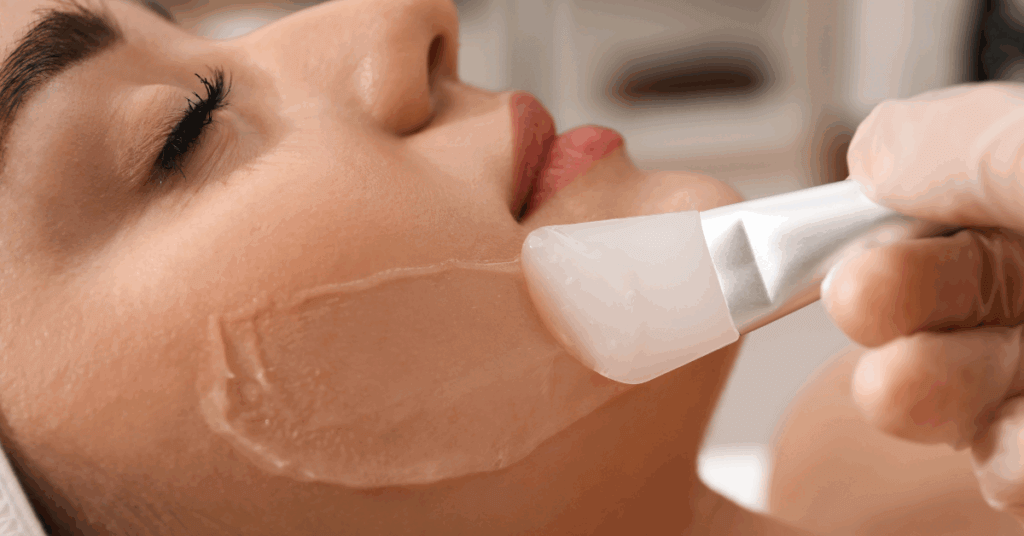
I can relate that there is something deeply gratifying about applying a peel-off mask, and after a few minutes peeling it off, knowing that in the stickiness of it all, dead skin cells are being removed.
Chemical peels and laser resurfacing remain transformative for dullness, pigmentation, and sun damage. However, the danger of overdoing them is a very real thing.
Here are some tips. Mild peels can be performed monthly, but medium-depth treatments such as TCA should be limited to two or three times a year. Lasers, while powerful, require downtime and shouldn’t be booked back-to-back.
At-Home Devices
Sales of at-home beauty tech have skyrocketed in the UK, with John Lewis reporting a 45 per cent increase in 2024. Microcurrent tools, LED masks, and radiofrequency wands have become living-room luxuries.
Used correctly, they can deliver impressive results. But used too often, they can wreak havoc. LED masks, for instance, are safe three to five times a week, while microneedling rollers should never be used more than once a month. Yet social media often glamorises daily use. One London influencer recently admitted she microneedled three times in a single week, resulting in inflamed skin that took months to recover.
Even Chrissy Teigen, known for her love of beauty gadgets, has spoken candidly about ‘overusing’ at-home devices in the past, reminding her followers that more doesn’t always mean better.
‘Skinimalism’
For every maximalist routine, there’s a growing number of women and men championing ‘skinimalism’. This is the trend of stripping skincare down to the essentials. Cleanser, moisturiser, and SPF are the backbone, with extras used only when necessary.
This movement appeals particularly to those weary of expense and complication. “A well-rounded routine doesn’t need twelve products,” says beauty journalist Alice Hart-Davis. “Sometimes less really is more.”
Even supermodel Gisele Bündchen has long credited her glowing complexion to a simple routine of water, natural oils, and sun protection. This is proof that a humble approach can shine on the world’s biggest catwalks.
If your skin feels persistently irritated, sore, or inflamed, you might have crossed the line. In that case, it’s time to ‘stop the madness’!