

From time immemorial, facial symmetry and proportion have been acknowledged as powerful markers of attraction. The ancient philosopher Aristotle said, “The chief forms of beauty are order and symmetry and definiteness.”
Centuries later prominent leader, Winston Churchill echoed his sentiments: “Tidiness is a virtue, symmetry is often a constituent of beauty.”
The concept of facial symmetry refers to the idea that one side of the face mirrors the other. While no human face is perfectly symmetrical, studies show that more symmetrical faces are generally rated as more attractive.
This perception isn’t just cultural conditioning. Evolutionary psychologists argue that symmetry is a visual cue of genetic fitness and developmental health. In a 2009 study published in Perception, participants consistently rated more symmetrical faces as more attractive, regardless of ethnicity or gender.
However, symmetry alone doesn’t tell the full story. The ‘golden triangle’ is another powerful visual principle. This triangle, formed between the eyes and chin, is considered an ideal shape for facial harmony.
In youthful faces, the base of the triangle is at the eyes and the point is at the chin. As we age, the triangle inverts due to skin laxity, volume loss, and the downward pull of gravity, resulting in a more square or trapezoid facial shape.
The golden ratio, 1:1.618, also comes into play. This mathematical ratio is found in nature, art, and architecture. It has long been considered aesthetically pleasing.
British plastic surgeon Dr Julian De Silva, based in Harley Street, noted in an interview in The Guardian: “Symmetry is a key factor, but the golden ratio provides a framework to quantify what we find beautiful.”
Dr De Silva used the golden ratio to rank celebrities’ faces for symmetry. He said that Amber Heard, Bella Hadid and Beyoncé topped the list.
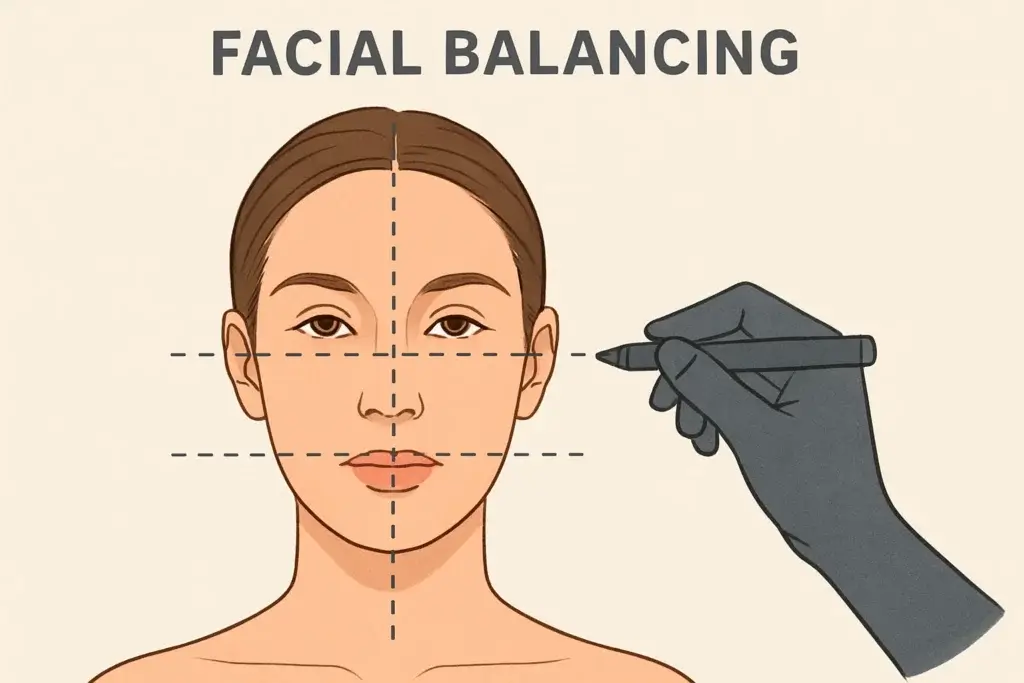
In the world of modern aesthetics, this fascination has evolved into a precise science. A technique called facial balancing has emerged. This uses advanced techniques to subtly enhance or restore harmony in the face. One of the clinics offering the treatment is the No Filter Clinic in London.
The No Filter Clinic in London aims to enhance natural beauty without the filters. The clinic offers a signature facial balancing treatment. This has become increasingly popular among clients seeking to improve their appearance without undergoing dramatic transformations.
The clinic’s founder, Dr Aggie, is known for her holistic, anatomy-led approach. “It’s not about chasing trends or trying to make someone look like someone else,” she said in a recent interview with Tatler UK. “It’s about restoring what may have been lost, enhancing what’s already there, and bringing the face into harmony. We always ask, how can we make this face flow more beautifully as a whole?”
The facial balancing treatment usually begins with an in-depth consultation and 3D facial analysis. This involves assessing the upper, middle and lower face sections; as well as evaluating asymmetries, bone structure, and volume distribution. Patients are photographed from multiple angles. Their facial proportions are then mapped according to aesthetic landmarks and ratios.
The treatment itself typically uses dermal fillers made of hyaluronic acid, a naturally occurring substance in the skin. Depending on the client’s needs, these may be applied to the cheeks, chin, jawline, lips, temples, or nose.
The aim is to sculpt the face into better visual alignment. The procedure is non-surgical, minimally invasive, and often completed in under an hour with little downtime.
“Facial balancing isn’t about making everyone look the same. Rather, it’s about making you look more like you on your best day,” Dr Aggie explains. “Our clients don’t want people to say, ‘Did you have work done?’ They want people to say, ‘You look amazing. What’s your secret?’”
UK Voices and the Rise of Subtle Aesthetics
The demand for facial balancing procedures has grown steadily in the UK. It is especially popular among professionals in their 30s to 50s who are seeking natural-looking results. According to the British College of Aesthetic Medicine, there has been a 40% increase in non-surgical facial procedures over the past three years, with symmetry correction and facial sculpting leading the way.
Beauty journalist Alice Hart-Davis, author of The Tweakments Guide, has observed this shift toward balance and subtlety. “We’re seeing a movement away from exaggerated features and toward treatments that enhance the natural harmony of the face,” she told Harper’s Bazaar UK. “Facial balancing allows for bespoke enhancements that reflect each person’s unique structure, which is a far healthier and more realistic approach.”
Social media has played a key role in this change, in addition to a wider cultural movement toward authenticity. Clinics like No Filter have tapped into this movement, offering treatments which are personalised, restrained, and rooted in scientific understanding rather than celebrity mimicry.
As the aesthetics industry continues to grow, the emphasis on natural beauty and proportion is likely to remain at the forefront.